
Extended Warranty Program Design and Compliance
An extended warranty program can create recurring revenue, strengthen customer retention, improve product confidence, and give a company more control over the post-sale customer relationship.
Designing an extended warranty program requires more than marketing a sales add-on - It's a regulated future promise.
When a customer buys an extended warranty, service contract, product protection plan, or customer guarantee, someone is agreeing to repair, replace, service, reimburse, or otherwise support that customer if a covered failure occurs. That promise has to be designed, priced, administered, regulated, funded, and financially backed.
What needs to be determined at the outset is who owns the customer promise, who administers claims, and how will the obligation be paid if claims occur?
That is the foundation of an extended warranty program.

Quick Answer: How Do You Build an Extended Warranty Program?
To build an extended warranty program, a company needs to define the customer promise, classify the product as a warranty or service contract, choose the provider or obligor, select an administrator, design the claims process, price the coverage, map state requirements, and determine how future claims will be financially backed.
Depending on the structure, the program may need reimbursement insurance, a service contract reimbursement insurance policy, a Contractual Liability Insurance Policy, a fronted insurance program, reserves, net worth support, or a captive-backed structure.
While software can manage the program and an administrator can process claims, neither one answers the core question:
Who owns the promise, and how will that promise be paid if claims occur?

What Is an Extended Warranty Program?
An extended warranty program is a structured customer-facing promise to provide repair, replacement, service, maintenance, reimbursement, or other support after the original product sale.
The program may be sold by a manufacturer, retailer, dealer, distributor, service provider, fintech platform, equipment company, or third-party program sponsor.
Extended Warranty Labels
Depending on the product and structure, the program may be called:
-
an extended warranty;
-
a service contract;
-
a product protection plan;
-
a protection program;
-
a maintenance agreement;
-
a repair plan;
-
a customer guarantee;
-
a home warranty;
-
a vehicle service contract;
-
a service warranty;
-
an insurance-backed warranty program.
The label matters, but the structure matters more.
Components of an Extended Warranty
A company can call something a warranty, guarantee, service plan, or protection product. That does not answer the real questions.
The real questions are:
-
What is being promised?
-
Is the customer paying separately for the promise?
-
Who is obligated to perform?
-
Who administers claims?
-
Who pays claims?
-
What state requirements apply?
-
Is the obligation insured, reserved, fronted, reinsured, or retained?
Those questions should be answered before the warranty program is sold.
Additional Revenue
An extended warranty can create a new revenue stream at the point of sale, after sale, through dealers, through retailers, or through an embedded platform.
Customer Confidence
A well-structured warranty program can reduce purchase friction, especially for expensive products, new technology, complex equipment, or products where repair costs are uncertain.
Better Customer Data
Warranty claims create data. They show where products fail, how often repairs occur, which parts are expensive, which customers use the program, and whether the product promise is priced correctly.
Brand Control
If a company owns the customer relationship after sale, it can control service quality, replacement standards, communications, and customer experience.
Dealer or Retailer Alignment
Retailers, dealers, and distribution partners often want protection products because they can improve close rates, increase margin, and reduce post-sale friction.
Risk Financing
At scale, warranty programs can become more than a sales add-on. They can become a structured risk-financing program involving reimbursement insurance, CLIPs, SCRIPs, fronting, reinsurance, reserves, or captives.
That is where warranty program design becomes more complex.
Steps to Create an Extended Warranty Program
An extended warranty program should be built in a deliberate sequence. Before a company sells the warranty, it needs to define the customer promise, determine who owns the obligation, design the claims process, price the risk, map state requirements, and decide how the future obligation will be financially backed.
The following steps outline the core structure behind a warranty, service contract, product protection plan, or customer guarantee program.
Step 1: Define the Customer Promise
An extended warranty program starts with the promise being sold. The company must clearly define whether the customer is buying repair, replacement, maintenance, reimbursement, service access, performance support, or another post-sale benefit.
Core questions:
-
What exactly is covered?
-
What failures, costs, or events are excluded?
-
Is the customer receiving repair, replacement, reimbursement, or service?
Why it matters:
The customer promise drives the contract wording, claims process, pricing model, state classification, and insurance structure. If the promise is unclear, the program will be difficult to price, administer, insure, or scale.

Step 2: Classify the Product
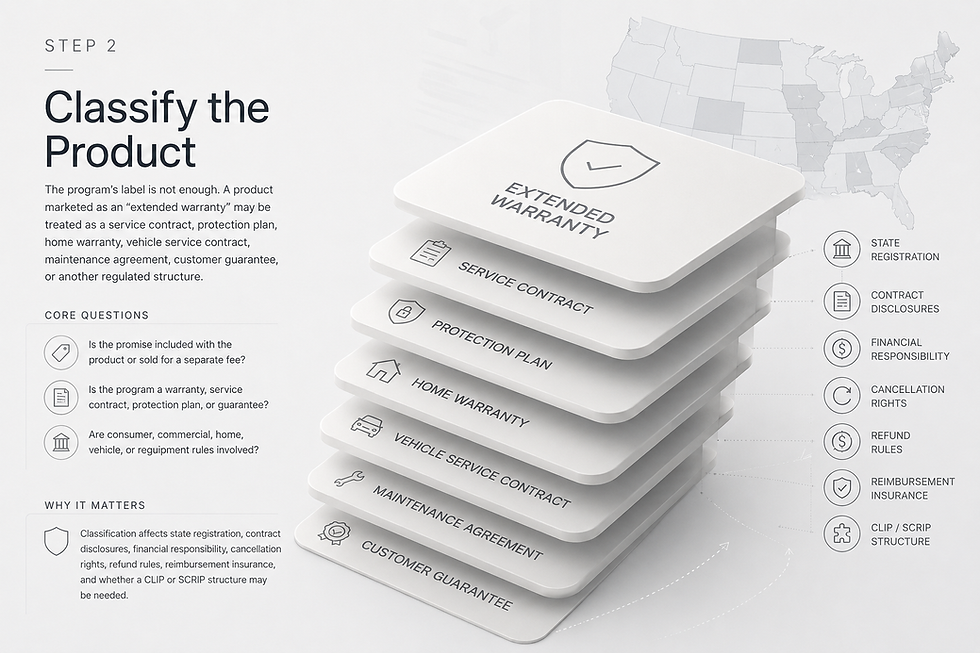
The program’s label is not enough. A product marketed as an “extended warranty” may be treated as a service contract, protection plan, home warranty, vehicle service contract, maintenance agreement, customer guarantee, or another regulated structure.
Core questions:
-
Is the promise included with the product or sold for a separate fee?
-
Is the program a warranty, service contract, protection plan, or guarantee?
-
Are consumer, commercial, home, vehicle, or equipment rules involved?
Why it matters:
Classification affects state registration, contract disclosures, financial responsibility, cancellation rights, refund rules, reimbursement insurance, and whether a CLIP or SCRIP structure may be needed.
Step 3: Choose the Provider or Obligor
The provider or obligor is the party that owns the customer-facing promise. This may be the manufacturer, seller, third-party provider, insurer, program company, or another entity.
Core questions:
-
Who is legally and financially responsible to the customer?
-
Is the seller also the obligor, or is a third-party obligor being used?
-
What happens if the obligor cannot perform?
Why it matters:
The obligor decision affects contract wording, regulatory filings, claims responsibility, reimbursement insurance, balance sheet exposure, retailer requirements, and customer protection.

Step 4: Select the Administrator
The administrator operates the warranty program. It may handle contract issuance, claims intake, service coordination, cancellations, refunds, customer service, data, and reporting.
Core questions:
-
Who receives and adjudicates claims?
-
Who manages records, cancellations, refunds, and customer communication?
-
Who reports claims and loss data to the provider, insurer, or reinsurer?
Why it matters:
Administration is operational control, not necessarily financial responsibility. A good administrator can run the process, but it does not replace the need to identify the obligor or financially back the promise.

Step 5: Design the Coverage Terms
Coverage terms define what the customer receives and what the program must pay for. Small wording choices can materially change claim frequency, severity, customer expectations, and insurer appetite.
Core questions:
-
What products, components, failures, and costs are covered?
-
What exclusions, limits, deductibles, waiting periods, and terms apply?
-
How are repair, replacement, reimbursement, and cancellation handled?
Why it matters:
Coverage terms determine the economics of the program. They also need to match the administrator’s capabilities, state requirements, service network, pricing model, and insurance or reimbursement structure.

Step 6: Build the Pricing and Claims Model
An extended warranty program should be priced around the expected cost of the promise, not just what the customer is willing to pay. The model should include claims, expenses, commissions, cancellations, insurer cost, reserves, and target margin.
Core questions:
-
What are expected claim frequency and severity?
-
What are the term length, claim lag, cancellation rate, and refund exposure?
-
Does the customer price support claims, expenses, commissions, and margin?
Why it matters:
Warranty revenue is often collected upfront, while claims may occur months or years later. A program can look profitable at sale and still fail if claims, service costs, or cancellation assumptions are wrong.

Step 7: Map State Requirements
Warranty and service contract rules vary by state. A national program may need to address registration, licensing, contract disclosures, reimbursement insurance, reserve requirements, net worth alternatives, and administrator rules.
Core questions:
-
In which states will the program be sold?
-
What does each state call the product or financial backing structure?
-
Are reimbursement insurance, reserves, net worth, filings, or registrations required?
Why it matters:
State terminology changes. Texas uses Contractual Liability Reimbursement Policy language. California and New York use service contract reimbursement insurance policy concepts. New Jersey focuses on reimbursement insurance and faithful performance. The structure should be built for the actual state footprint.
Example State Planning Issues:
-
Texas: Uses Contractual Liability Reimbursement Policy and reimbursement insurance language in service contract financial security structures.
-
California: Uses service contract reimbursement insurance policy and obligor concepts.
-
New Jersey: Uses reimbursement insurance policy and faithful performance concepts.
-
New York: Uses Article 79 and service contract reimbursement insurance policy concepts.
-
Florida: Has distinct service warranty association, home warranty association, and motor vehicle service agreement frameworks.
-
Washington: Recognizes service contract provider, reimbursement insurance, and CLIP-related concepts.
-
Pennsylvania: Generally frames qualifying service contracts through a service contract exclusion rather than the same reimbursement insurance terminology used in some other states.
It means the warranty program should be designed with the state footprint in mind.
A program that works in one state may need changes before it can be sold nationally.

Step 8: Choose the Financial Backing Structure
The warranty is the promise. The financial backing is what supports the promise if claims occur. This may involve reimbursement insurance, CLIP, SCRIP, reserves, net worth support, fronting, reinsurance, or captive participation.
Core questions:
-
Who pays claims first?
-
Who reimburses the provider or obligor?
-
Is risk transferred, retained, shared, fronted, or financed through a captive?
Why it matters:
Ordinary business insurance is not the same as warranty reimbursement insurance or a CLIP-backed structure. The backing must match the contract obligation, state requirements, claims process, and long-term economics.

Step 9: Build Claims and Service Operations
Claims are where the warranty program becomes real. The company needs a process for claim submission, coverage review, repair approval, vendor payment, customer reimbursement, escalation, fraud control, and reporting.
Core questions:
-
How does the customer submit a claim?
-
Who approves, denies, pays, or escalates the claim?
-
Who performs repairs or replacements, and how are vendors paid?
Why it matters:
Poor claims operations can create customer complaints, regulatory issues, retailer friction, and bad loss data. The claims process needs to align with the contract, administrator, service network, provider, and financial backing structure.

Step 10: Track Performance and Optimize
A warranty program should be monitored like an underwriting portfolio. The company should track attachment rate, claim frequency, claim severity, loss ratio, cancellation rate, service cost, customer outcomes, and margin by product, channel, and state.
Core questions:
-
Is the program profitable by product, channel, and state?
-
Are claims developing as expected?
-
Does the data support better pricing, coverage terms, insurance terms, or captive participation?
Why it matters:
The data is the long-term value of the program. It can improve pricing, support underwriting, reveal product defects, reduce fraud, strengthen service quality, and eventually justify a more advanced risk structure such as a captive or fronted program.

Software does not determine
Whether the product is a warranty or service contract;
-
who is obligated to the customer;
-
whether the program needs reimbursement insurance;
-
what state requirements apply;
-
who funds claims;
-
whether reserves are required;
-
whether a CLIP or SCRIP is appropriate;
-
whether the company should use a third-party obligor;
-
whether a captive or fronted structure makes sense.
Software is not the promise
Softwared does not own the promise. That is why companies should not start by buying warranty software before designing the warranty structure.The structure comes first.The software should support the structure.
Administrator Is Not the Same as Obligor
The administrator and obligor are often confused. They should not be.
The administrator may operate the program.
The obligor or provider owns the customer promise.The difference matters.
And while a company can outsource administration, it cannot ignore obligation. If the obligor structure is wrong, the program can create regulatory problems, claim disputes, customer confusion, and unplanned balance sheet exposure.
Seller
Sells or offers the warranty or service contract.
Obligor / Provider
Is contractually, financially, or legally responsible to the customer.
Administrator
Handles program administration, claims, records, cancellations, and reporting.
Service Network
Repairs, replaces, inspects, or services the covered product.
Insurer / Reimbursement Insurer
Supports covered obligations under the policy structure.
Captive / Reinsurer
May retain or reinsure a layer of program risk.
The Financial Backing Decision
The financial backing decision is where URM’s analysis usually begins.
Companies often ask "Can we insure this warranty?” What we want to understand is What obligation are we trying to insure, reimburse, front, retain, or finance? And the answer depends on the customer promise and program structure.
Reimbursement Insurance
A reimbursement insurance policy may reimburse or pay on behalf of the provider or obligor for covered service contract obligations. In some states, it may also provide a path for the customer if the provider does not perform.
Service Contract Reimbursement Insurance Policy
Some states use this phrase for insurance backing tied to service contract obligations. California and New York are important examples.
Contractual Liability Insurance Policy
A CLIP is broader insurance-market terminology for a policy designed to support certain contractual obligations assumed by the insured. In warranty and service contract programs, a CLIP may be part of the financial backing structure.
SCRIP
SCRIP is often used to describe service contract reimbursement insurance policy structures tied more directly to service contract obligations.
Fronted Program
A fronted warranty program may involve an admitted or authorized insurer issuing paper while risk is transferred, reinsured, retained, or shared through another structure.
Captive-Backed Warranty Program
At scale, a company may want to retain part of the warranty economics through a captive. This may allow the company to participate in underwriting profit, control data, and build a long-term risk-financing strategy.
Contractual Liability Reimbursement Policy
Texas uses Contractual Liability Reimbursement Policy language in insurance form review materials. This phrase is closely related to the broader CLIP and reimbursement insurance conversation.
Reserve or Net Worth Structure
Some states may allow reserve or net worth alternatives. These can be useful for large companies, but they may tie up capital or be unrealistic for startups and smaller programs.
The structure should be designed around the promise, not the other way around.
A CLIP is not the warranty itself.
The warranty or service contract is the customer-facing promise. The CLIP may be the insurance structure behind that promise.
In some programs, the better phrase may be reimbursement insurance, service contract reimbursement insurance policy, SCRIP, or contractual liability reimbursement policy.
The terminology depends on the product, state, contract form, provider structure, and insurer, but the planning point is the same:
The company should identify the contractual obligation before trying to insure it.
When a Captive is Attractive
The company has credible claims data;
-
the program has consistent volume;
-
pricing can support expected losses and margin;
-
claims are predictable enough to underwrite;
-
the company wants to retain underwriting profit;
-
the company wants more control over warranty economics;
-
a fronted structure is available;
-
capital and regulatory requirements can be satisfied;
-
the company wants portfolio-wide value creation.
For private equity-backed companies, manufacturers, equipment businesses, retailers, and platforms, warranty economics can become an enterprise value issue.
If the warranty program is profitable, transferring all economics to a third party may not be the best long-term structure.
A captive or risk-sharing structure may allow the company to own more of the economics while still supporting the customer promise.
Industries That Should Think About Extended Warranty Program Design
Extended warranty program design is relevant for any company selling a meaningful post-sale promise.
Extended Warranty Examples Include
-
consumer product manufacturers;
-
commercial equipment companies;
-
commercial refrigeration providers;
-
foodservice equipment businesses;
-
backup power and generator companies;
-
HVAC and home services platforms;
-
pool and outdoor system providers;
-
home energy and battery companies;
-
EV charging infrastructure companies;
-
appliance and electronics companies;
-
modular housing and manufactured housing businesses;
-
equipment dealers and distributors;
-
fintech platforms with customer guarantees;
-
embedded protection platforms;
-
private equity-backed service and equipment platforms;
-
retailers offering product protection plans.
The more expensive the product, the longer the warranty term, and the more complex the service obligation, the more important the structure becomes.
What Insurers and Program Partners Will Ask For
Before approaching insurers, administrators, program partners, or fronting carriers, a company should be ready to provide a clear submission package.
That package may include:
-
description of the product or service;
-
draft warranty or service contract form;
-
customer-facing promise;
-
covered failures;
-
exclusions;
-
warranty term;
-
claim limits;
-
deductible or service fee;
-
expected annual sales volume;
-
expected attachment rate;
-
customer price;
-
dealer or retailer commission;
-
administrator fees;
-
service network details;
-
expected claim frequency;
-
expected claim severity;
-
repair or replacement cost data;
-
historical warranty data;
-
product failure data;
-
cancellation and refund assumptions;
-
state footprint;
-
provider or obligor structure;
-
administrator structure;
-
claims workflow;
-
loss-control process;
-
fraud-control process;
-
requested insurance or reimbursement structure;
-
desired risk retention;
-
captive or reinsurance goals.
A better submission produces a better underwriting result.
A vague program produces vague or expensive insurance options.
Common Mistakes When Building an Extended Warranty Program
Mistake 1: Starting With Software
Software is useful, but it is not the structure.
The company still needs to decide who owns the obligation, who funds claims, and what financial responsibility requirements apply. We are happy to refer you to software providers.
Mistake 2: Confusing Administrator With Obligor
The administrator may process claims.
The provider or obligor owns the promise.
Those are different roles.
Mistake 3: Selling Before Mapping State Requirements
A program that works in one state may need changes before it is sold in another (State Guides).
Mistake 4: Underpricing Long-Tail Claims
The warranty may be sold today, but claims may occur years later.
The economics need to reflect claim lag, severity, cancellation, inflation, and service costs.
Mistake 5: Assuming General Liability Covers the Promise
Ordinary general liability insurance is not the same as reimbursement insurance, CLIP, SCRIP, or a contractual liability reimbursement structure.
Mistake 6: Giving Away the Economics Too Early
Some companies outsource the entire program before understanding whether they could retain a portion of the economics through a captive, fronted program, reinsurance, or risk-sharing structure.
Mistake 7: Failing to Own the Data
Claims data is the foundation of pricing, underwriting, quality control, and long-term warranty economics.
If the company does not control the data, it may not control the future value of the program.
FAQs
How do you build an extended warranty program?
You build an extended warranty program by defining the customer promise, classifying the product, choosing the provider or obligor, selecting an administrator, designing coverage terms, building a claims and pricing model, mapping state requirements, and choosing the financial backing structure.
What do you need to start an extended warranty program?
A company needs a defined contract, covered products, pricing model, claims process, administrator, provider or obligor, state compliance review, and financial backing plan. Depending on the structure, the program may need reimbursement insurance, a CLIP, SCRIP, reserve account, fronted program, or captive-backed structure.
Is an extended warranty the same as a service contract?
Not always. An extended warranty may be marketed as a warranty, but if it is sold separately and promises repair, replacement, maintenance, service, or reimbursement, it may be treated as a service contract in many states. The classification depends on the product, terms, fee structure, and applicable state law.
Who is the obligor in an extended warranty program?
The obligor is the party financially and legally responsible for the customer-facing promise. The obligor may be the manufacturer, seller, provider, insurer, third-party obligor, or another program entity, depending on the structure.
What is the difference between an administrator and an obligor?
The administrator operates the program and may handle claims, records, cancellations, service, and reporting. The obligor owns the promise and is responsible for performance under the warranty or service contract. The administrator and obligor may be different entities.
Do you need insurance to sell extended warranties?
It depends on the structure and state footprint. Some programs may use reimbursement insurance, service contract reimbursement insurance, CLIP, SCRIP, reserves, net worth support, fronting, or captive-backed structures. Some states impose specific financial responsibility requirements.
What is reimbursement insurance for an extended warranty program?
Reimbursement insurance is insurance that may reimburse or pay on behalf of the provider or obligor for covered service contract or warranty obligations. In some structures, it may also support contract holders if the provider does not perform.
What is a CLIP in an extended warranty program?
A CLIP, or Contractual Liability Insurance Policy, is insurance designed to support certain contractual obligations assumed by the insured. In an extended warranty program, a CLIP may sit behind the customer-facing promise and support defined repair, replacement, reimbursement, or service obligations.
What is a SCRIP?
SCRIP generally refers to a service contract reimbursement insurance policy. It is often used in service contract programs where insurance backs the provider’s contractual obligations.
Can a company retain warranty risk in a captive?
Yes, if the program has enough scale, data, claims discipline, and capital support. A captive may allow a company to retain part of the warranty economics while using fronting, reinsurance, or other structures to support the customer promise.
What data do insurers need to underwrite an extended warranty program?
Insurers typically want the contract form, covered products, term length, expected sales volume, pricing, claims assumptions, historical loss data, repair or replacement costs, administrator details, provider or obligor structure, state footprint, claims process, and requested financial backing structure.
Related URM Resources
Use these resources to evaluate the structure before launching a warranty or service contract program:


